Bénédicte begins corresponding with Reinhardt
L'Amour et les ForêtsBénédicte Ombredanne begins corresponding with Éric Reinhardt after reading his novel, first approaching him in a letter whose wit and indignation conceal as much vulnerability as they disclose. The exchange moves from literary enthusiasm to something more urgent: through her reading of his book, Bénédicte describes the possibility of accepting her contradictions and inventing a life that might become real. The correspondence matters both as a meeting between writer and reader and as Bénédicte’s first recorded attempt to make her inner complexity speak.
The first letter and its occasion
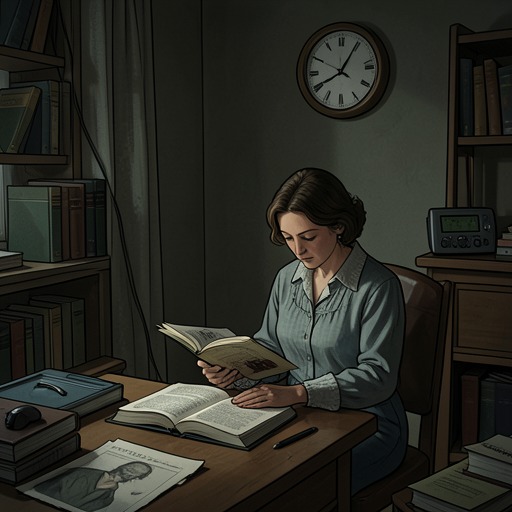
Bénédicte’s first letter catches Éric Reinhardt through its unusual blend of feeling and humor. It is two pages long and, as he remembers it, begins cautiously before growing fiercer and more dissatisfied. Its irony, unruly energy, and almost schoolyard clamor suggest a writer pushing herself forward before she can retreat. Éric reads the letter’s mixed register—respectful yet bold, serious yet playful, intelligent yet almost childlike—as a sign of a person trying to escape a situation that has become painful or intolerable. He recognizes that this is an intuition, not a conclusion he can substantiate from particular passages; the letters’ later disclosures, he says, confirmed his first impressions.
The immediate cause of Bénédicte’s anger is specific: her application to join the readers’ jury for a literary prize has been rejected. What disappoints her most is not simply losing a place on the jury, but losing the chance to influence its discussions in favor of Éric’s novel. The letter thus arrives as both a protest against exclusion and an expression of literary allegiance. Bénédicte includes her email address beneath her signature, giving Éric a way to answer. He writes the next day to thank her, telling her that the two pages delighted him, that he found them witty and beautiful, and that he felt proud to have a reader of her quality.
A reader writes back
A few weeks later, Bénédicte sends an email describing what she valued in the novel. Unlike her first letter, this one contains no humor; Éric recalls it as beautiful, vibrant, and luminous. Its emotional force comes partly from what it leaves unnamed. Bénédicte does not identify the obstacles confronting her or say whether they arise within herself, at work, or in her family. Instead, her account conveys distress through the intensity of her resistance: she appears to believe that, if she keeps wanting it, happiness may still become possible.
Éric understands her attachment to books as more than ordinary admiration. In his reading, she treats beloved books as a lifeline, as though they could turn toward her and draw her out of a depth from which she has nearly stopped expecting rescue. He sees an affinity between that hope and his own expectation that writing might carry him toward an ideal elsewhere. This parallel does not erase the difference between author and reader: Bénédicte is responding to a novel as someone in need of what it can make imaginable, while Éric is learning how consequential that need can be.
Reading as a way to become whole
Bénédicte’s interpretation centers on the novel’s four characters. She understands them as distinct figures whose convergence brings into being a reconciled person, one who remains after the book is closed. The characters, in her account, resemble one another and function as variations of a single individual; their combination gives the novelist who contains them a particular intensity. The book’s structure offers her a model for thinking about the self: separate and conflicting pieces of experience need not remain irreconcilable. Placed together, they may form a more complete person, though the seams and fractures do not disappear.
This reading leads Bénédicte to a practical, personal conviction. She has felt better after reading the novel, she tells Éric, because it suggests that a person who experiences herself as fragmented can nevertheless become more unified. She sees the character of the novelist as the figure able to find moments of calm and illumination where the other characters lose their way. What she takes from that contrast is permission to accept her own strangeness rather than treat it as something to hide. Her letter applies the novel’s idea to the act of writing itself: sending an audacious message to a man she has never met becomes one small attempt to live with less concealment.
Invention and the correspondence’s significance
Bénédicte also tells Éric that she had known nothing about him before a bookseller recommended the novel. For that reason, she read the Éric Reinhardt who appears in it as a fictional character, no less invented than the other three. Even details presented as drawn from his real life seemed to her to belong to the novel’s imaginative world. That assumption gives her a way to understand fiction not as an escape from reality but as evidence that a life, too, might be remade. The book’s blue cover and white pages become part of her formulation: invention matters when it can become real in a reader’s hands and, by extension, in a reader’s life.
Bénédicte concludes that she intends to invent herself from then on, day by day and whenever she can, in the hope of making her life more beautiful. She thanks Éric for reading her lengthy message, apologizes for dwelling on her own response rather than discussing the novel in greater detail, and promises to be less talkative next time. Her farewell is as subdued as the Lorraine February weather she evokes. Éric, meanwhile, comes away with a sharper sense that several conflicting selves inhabit Bénédicte, and that she has had to keep most of them silent. The correspondence therefore records more than a reader’s praise: it captures her effort to choose who she might become, and the novel that gives that effort a language.